
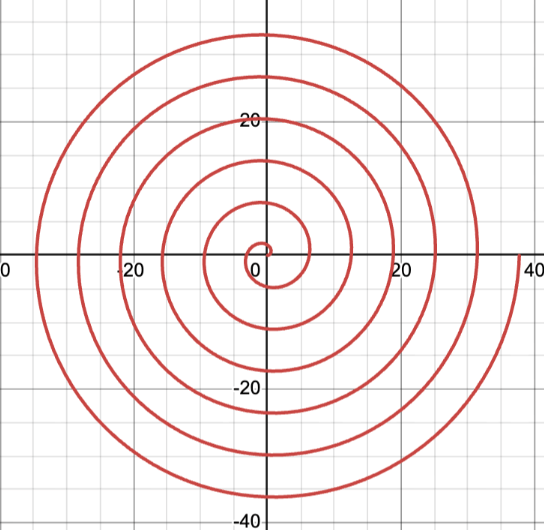
There is one topic in calculus (that has led me to research and discuss our next mathematician today) that often separates students into ordinary and extraordinary: the differentiation and integration of polar curves. The transition to polar coordinates from the Cartesian plane feels weird to an unnatural extent. The traditional x and y axes are replaced with the coordinates (r, θ), a seemingly inadequate representation of points on the polar plane. How can you even pinpoint coordinates with just one quantifiable length? Better yet, why do polar curves even exist? What purpose do they serve practically?
In fact, it is the polar plane that we learn far later down the road in the school curriculum that was established more than a millennium before the classic (x, y) Cartesian plane! The genius behind one of the first polar curves ever graphed was none other than Archimedes of Syracuse. Born around 287 BCE in Syracuse, Italy (but also a Greek city-state at the time), Archimedes was brought up in an environment that cultivated his mathematical explorations and ambitions.
Archimedes was far more than a theoretical dreamer; indeed, he was also a man of foresight. While he communicated his discoveries through letters to the greatest scholars of his age, his genius was most famously displayed during the Siege of Syracuse in 213 BCE. He engineered defensive war machines so effective they held the Roman fleet at bay for years, only to be killed during the city’s eventual fall. Reportedly, this happened fittingly while he was too distracted by geometric figures drawn in the sand to notice the invading soldiers. Though the formal invention of calculus by Newton and Leibniz lay nearly two millennia in the future, Archimedes was already knocking on the door.
He utilized the method of exhaustion, a geometric precursor to integration that involved inscribing and circumscribing polygons within a shape to exhaust its area. By increasing the number of sides on these polygons, he could approximate areas and volumes with startling precision. This logic is the direct ancestor of the modern limit (as we take the number of polygons to infinity), proving that Archimedes was performing integral calculus before the world even had the symbolic language to describe it. The crown jewel of his work in polar logic is the Spiral of Archimedes, defined by the elegant equation r = θ. Despite how simple it looks, this curve infinitely circles around the origin, expanding outward infinitely. Unlike other spirals that expand exponentially, this curve grows at a constant rate: as the angle increases, the distance from the origin increases linearly. Archimedes’ obsession with geometric ratios led to his most prized discovery: the proof that the volume of a sphere is exactly two-thirds that of its circumscribing cylinder. He considered this his greatest achievement, requesting it be engraved on his tomb.
I was quite interested in a different contribution of Archimedes to the math world for a while: the approximation of π as 22/7. Although another concise fraction that is a little more obscure, 355/113 represents the value of π significantly more accurately, Archimedes’ estimate was revolutionary at the time. Throughout the years I have spent in math classes growing up, I have seen this approximation several times over, and I always wondered how this simple fraction accurately represents π to the hundredths place. Archimedes managed to provide the ancient world with its most accurate estimate of π by calculating the perimeters of 96-sided polygons, pinning the constant between 223/71 and our well-known friend, 22/7. From the displacement of water in a bathtub to the mechanics of the lever, Archimedes treated mathematics as a tool to unlock the physical world.
Today, his weird polar curves are the backbone of everything from designing spiral antennas and microphone patterns to modeling planetary motion, reminding us that calculus didn’t start with a textbook; it started with a spiral.
Bibliography
“Archimedes.” Wikipedia: The Free Encyclopedia, Wikimedia Foundation, 4 Feb. 2026, en.wikipedia.org/wiki/Archimedes.
Casselman, Bill. “Archimedes and the Method of Exhaustion.” University of British Columbia Department of Mathematics, personal.math.ubc.ca/~cass/courses/m446-03/exhaustion.pdf. Accessed 7 Feb. 2026.
Damini, D. B., and Abhishek Dhar. “How Archimedes Showed that π is Approximately Equal to 22/7.” arXiv, 18 Aug. 2020, arxiv.org/abs/2008.07995.
Gardner, Robert. “Archimedes: The Volume of a Sphere.” Geometry Notes, East Tennessee State University, faculty.etsu.edu/gardnerr/Geometry/notes-OW/Geometry-OW-4-2.pdf. Accessed 7 Feb. 2026.
Miel, George. “Of Calculations Past and Present: The Archimedean Algorithm.” The American Mathematical Monthly, vol. 90, no. 1, 1983, pp. 17-35. Wayback Machine, web.archive.org/web/20150905063500/http://www.maa.org/programs/maa-awards/writing-awards/of-calculations-past-and-present-the-archimedean-algorithm. Accessed 7 Feb. 2026.
The Editors of Encyclopædia Britannica. “Spiral.” Encyclopædia Britannica, 23 Sep. 2022, www.britannica.com/science/spiral-mathematics. Accessed 7 Feb. 2026.
Toomer, Gerald J. “Archimedes.” Encyclopædia Britannica, 1 Jan. 2024, www.britannica.com/biography/Archimedes. Accessed 7 Feb. 2026.
 Beautiful Minds
Leave a comment