Nobody watching June Huh in his teenage years would have guessed that within two decades he’d hold mathematics’ highest honor, the Fields Medal, for work so original it required building a working piece of geometry for objects that have no actual geometric shape at all. But the path from one to the other wasn’t just a detour, and also didn’t happen merely by chance; it was the same mind doing the same thing but in a different medium. Huh was always going past the surface in whatever he investigated and researched, whether that something was a poem or a math problem.
His first real exposure to analytical thinking in the style that would shape his career came from a video game: The 11th Hour. In the game, Huh was presented with a peculiar-looking chess puzzle that looked like this:
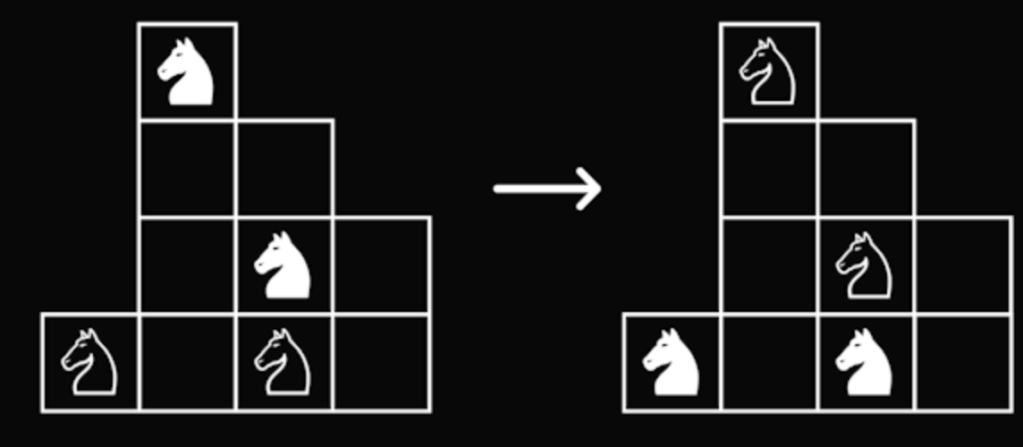
(Image Credit: https://mindyourdecisions.com/blog/2025/11/14/chess-puzzle-from-the-11th-hour-video-game/)
The goal was to swap the original positioning of the white knights and the black knights following conventional chess rules in this very unconventional setup and board configuration. When I first looked at this as an experienced chess player, I thought that there was no way this puzzle would take long: the board size was small, and there were only four pieces to even consider. However, the longer I stared at it, the more I realized the nuance in the puzzle: the knights quickly get in the way of each other and rely on the key middle square where the white knight starts on. There is seemingly no convenient way to move them where you want to with only L-shaped moves. Which is what I thought.
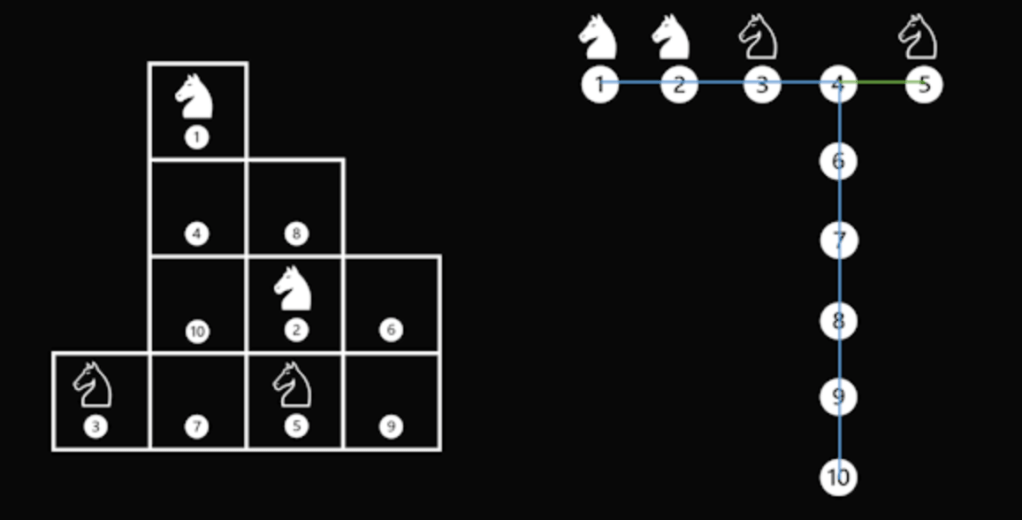
After a few days of being stumped, Huh came up with an ingenious idea to get the knights into the desired configuration. He realized that the board’s shape and the knight’s movement pattern don’t actually matter at all, only the underlying graph of which square connects to which. Once he reframed the board in the puzzle as a graph, the puzzle became a question about moving the pieces along a fixed structure, with each square corresponding to a point on this tree. This is where the breakthrough came: although the knights kept getting in each other’s way earlier, the tree revealed that there was actually one crevice where the knights can actually hide to let the others “pass by” and reorganize themselves! In this fashion, June Huh solved a fascinating math puzzle that had the outward appearance of chess.
At sixteen years old, June Huh left high school to become a poet. It would be years before he found his way to a college classroom at all, let alone one that would change the direction of his life. In his sixth year of college, he sat in on Professor Heisuke Hironaka’s class (Hironaka also won the Fields Medal in 1970), and everything changed. He had never before seen math done live so intuitively, and he found math to be like a work of art with its own expression for the first time. The material was fascinating to Huh, but at the same time, it was arduous and difficult. The class started at around 200 students and quickly dwindled to a handful within weeks: Huh stayed though and was a part of the surviving cohort. He went on to do a master’s under Hironaka, then a PhD at Michigan. He became a member of Princeton faculty in 2021 where he currently works today, and later won his Fields medal in 2022.
This same instinct is in a real sense, the exact move that would define his mathematical career decades later, just aimed at something far more abstract than four knights.
At the center of Huh’s Fields Medal work sits an object called a matroid. A matroid takes the idea of “linear independence” from linear algebra (which vectors in a set can’t be written as combinations of the others) and keeps only that pattern, discarding the vectors themselves. You can build a matroid from an actual collection of vectors, but most matroids don’t come from vectors at all. They’re pure combinatorial structure, with nothing underneath them.
Every matroid carries a characteristic polynomial, and in the late 1960s, Gian-Carlo Rota conjectured that its coefficients always behave in a strikingly orderly way: log-concave, rising and falling in a single smooth arc, generalizing an earlier conjecture about the colorings of graphs. When a matroid does come from an actual algebraic variety, its Hodge theory, the machinery built to describe the shape of varieties, forces it directly. But most matroids have no variety. The conjecture, in full generality, was a claim about objects that the existing tools had no way to touch.
Huh’s first breakthrough, with Eric Katz, handled the matroids that did come from vector spaces, by relating their coefficients to intersection numbers on an actual geometric variety built for the purpose. But the deeper leap came a few years later, with Katz and Karim Adiprasito: they constructed a ring attached to any matroid at all, representable or not, that satisfied its own version of Hodge theory’s key relations: with no variety underneath it to justify them. It was, in Huh’s own words, the realization that you don’t need space to do geometry. The construction fully resolved Rota’s conjecture, along with several others that had stood alongside it for decades.
Huh has described poetry, art, and mathematics as beginning with the same thing: an intuition that something is true before there are words to express it. It’s likely that instinct was there all along. From seeing a chessboard as a graph to building geometry for objects with no geometry at all, the underlying way of thinking never did. He shows us that sometimes, the biggest breakthroughs come not from seeing more, but from seeing through.
Bibliography:
Adiprasito, Karim, June Huh, and Eric Katz. “Hodge Theory for Combinatorial Geometries.” Annals of Mathematics, vol. 188, no. 2, 2018, pp. 381–452.
Baker, Matt. “Hodge Theory in Combinatorics.” Matt Baker’s Math Blog, 14 Dec. 2015, mattbaker.blog/2015/12/14/hodge-theory-in-combinatorics/. Accessed 7 July 2026.
“June Huh.” MacArthur Foundation, 2022, www.macfound.org/fellows/class-of-2022/june-huh. Accessed 7 July 2026.
“June Huh.” Wikipedia, Wikimedia Foundation, 22 Apr. 2026, en.wikipedia.org/wiki/June_Huh. Accessed 7 July 2026.
Huh, June, and Eric Katz. “Log-Concavity of Characteristic Polynomials and the Bergman Fan of Matroids.” Mathematische Annalen, vol. 354, 2012, pp. 1103–1116.
Klarreich, Erica. “June Huh, High School Dropout, Wins the Fields Medal.” Quanta Magazine, 5 July 2022, www.quantamagazine.org/june-huh-high-school-dropout-wins-the-fields-medal-20220705/. Accessed 7 July 2026.
Silver, Albert. “The Chess Puzzle That Led to a Fields Medal.” ChessBase, 21 July 2022, en.chessbase.com/post/the-chess-puzzle-that-led-to-a-fields-medal. Accessed 7 July 2026.
“June Huh, Combinatorics, and the Strange Allure of Chess Knight Problems.” Heidelberg Laureate Forum Foundation, newsroom.hlf-foundation.org/blog/article/june-huh-combinatorics-and-the-strange-allure-of-chess-knight-problems/. Accessed 7 July 2026.


Leave a comment