Variables are nothing new to us today; letters such as x and y represent unknown numerical values, and equations such as x² – 5x + 6 = 0 are now relatively straightforward for most who have completed Algebra 1.
But we don’t often stop to consider: how strange was this notation and way of thinking centuries ago? After all, algebra was still developing immensely in the sixteenth century; negative numbers were considered controversial, and the square roots of negative numbers were especially problematic.
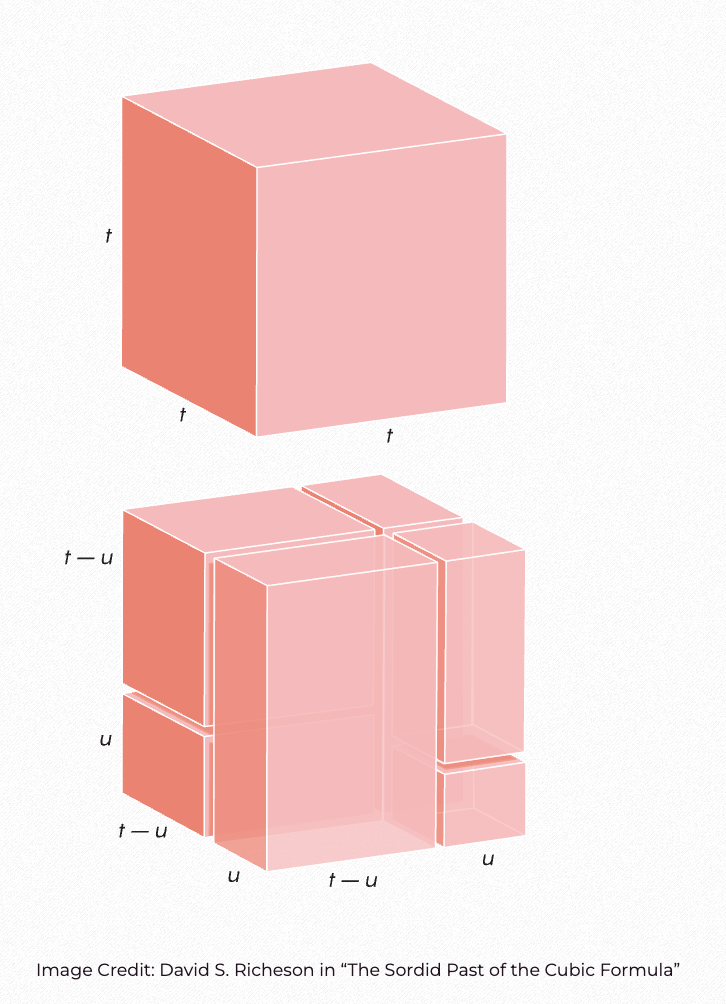
The problem was that algebra was still closely connected to geometric interpretations. No one could ever imagine a shape with a negative side length or area, and rightly so. However, one man saw that there was no need for algebra to be strictly tied to the rules of geometry: Girolamo Cardano, a great mathematician and polymath who published “Ars Magna” (The Great Art).
Historically, quadratic equations were relatively well understood, as mathematicians had developed several established methods for solving them. Cubic equations, however, presented a much greater challenge. Without the computational tools we have today, mathematicians had to rely entirely on algebraic techniques and lengthy calculations. Some cubic equations were relatively easy to solve, particularly when their roots were simple integers. Others, however, resisted these straightforward approaches, and mathematicians struggled to find a general method that could be applied to them.
One important step toward solving this problem came from studying a particular form of the cubic equation: the depressed cubic. Unlike the general cubic equation that has a squared term, the depressed cubic takes on a simpler form without it:
Removing the squared term made this variation of the cubic easier to work with, but finding a reliable method to solve it was still a significant challenge.
It wouldn’t be an exaggeration to say that the history behind this discovery is as fascinating as the math itself. In the early sixteenth century, the Italian mathematician Scipione del Ferro discovered a method for solving a particular class of depressed cubic equations. However, he kept his discovery secret. The livelihood of mathematicians back in this era depended on their ability to solve problems better than their competitors, so del Ferro wanted to retain his advantage over his competitors.
Some years later, another Italian mathematician, Niccolò Tartaglia, independently discovered a method for solving the same type of equation. His discovery eventually attracted the attention of Girolamo Cardano—a polymath and mathematician who was eager to learn the technique. After Cardano promised to keep it secret, Tartaglia shared his method with him.
Because del Ferro’s discovery predated Tartaglia’s, Cardano believed that he had the grounds to publish the solution to the cubic. In 1545, he did exactly that, including the method in his famous work, “Ars Magna”.
Yet Cardano’s contribution extended beyond publishing someone else’s discovery: Tartaglia’s method applied only to the form of the cubic equation without the x2 term, but Cardano developed a way to transform a general cubic into a depressed cubic, allowing the solution method to be applied to a much broader set of equations. By using a suitable substitution to eliminate the squared term, he showed that the complicated general equation could be reduced to one whose solution was already known.
To see how this works, consider the following general cubic equation:
1. Start with a general cubic equation:
2. Divide everything by A:
3. Now make the substitution:
4. This substitution eliminates the squared term, leaving:
Significantly, “Ars Magna” brought together several important discoveries and demonstrated the progression of algebra over the years. It was more than a collection of formulas: it was a major step toward modern mathematics and became one of the most influential works in the history of algebra.
But while Cardano’s work brought mathematicians closer to solving cubics, it also led him into something more unexpected: calculations involving the square roots of negative numbers, and eventually, the discovery of imaginary numbers.
Consider the following equation:
x² + 4 = 0
Rearranging gives:
x² = -4
Taking the square root of both sides leaves us with:
x = ±√(-4) = ±2i
Today, we know that x = ±2i, where i is the imaginary unit, which is equal to √(-1). However, this result would have been deeply perplexing to a sixteenth-century mathematician. How could a number squared produce a negative result? Negative numbers themselves were still difficult to interpret, and their square roots seemed even more unreasonable. These quantities had no obvious geometric interpretation and seemed impractical.
Cardano himself recognized the existence of square roots of negative numbers but struggled to assign any meaningful interpretation to them and brushed them off as insignificant.
What he couldn’t fully appreciate was that these seemingly impossible quantities were an early glimpse of an entirely new class of numbers.
Mathematician Rafael Bombelli picked up where Cardano left off several decades later. He developed rules for manipulating imaginary quantities, establishing them as a legitimate tool. Eventually, mathematicians developed the modern theory of complex numbers that follow the form a+bi. Here, a represents the real component and b the coefficient of the imaginary component of any complex number.
Today, complex numbers are fundamental to many areas of mathematics and applied sciences. Of course, Cardano himself did not develop the modern theory of complex numbers, but his willingness to explore messy algebraic calculations helped pave the way for the development of modern algebra for others.
Bibliography
Cardano, Girolamo. Ars Magna or The Rules of Algebra. Translated by T. Richard Witmer, Dover Publications, 1993.
Dunham, William. Journey Through Genius: The Great Theorems of Mathematics. Penguin Books, 1990.
Helfgott, Harald, and Michel Helfgott. “A Modern Vision of the Work of Cardano and Ferrari on Quartics.” Mathematical Association of America.
O’Connor, J. J., and E. F. Robertson. “Girolamo Cardano.” MacTutor History of Mathematics Archive.
O’Connor, J. J., and E. F. Robertson. “Quadratic, Cubic and Quartic Equations.” MacTutor History of Mathematics Archive.
Veritasium. “How Imaginary Numbers Were Invented.” YouTube, 1 Nov. 2021.
Whittaker, E. T. “The Origin of Complex Numbers.”
“History of Negative Numbers.” NRICH, University of Cambridge.


Leave a Reply